
Artificial Reason, Reasonator.de
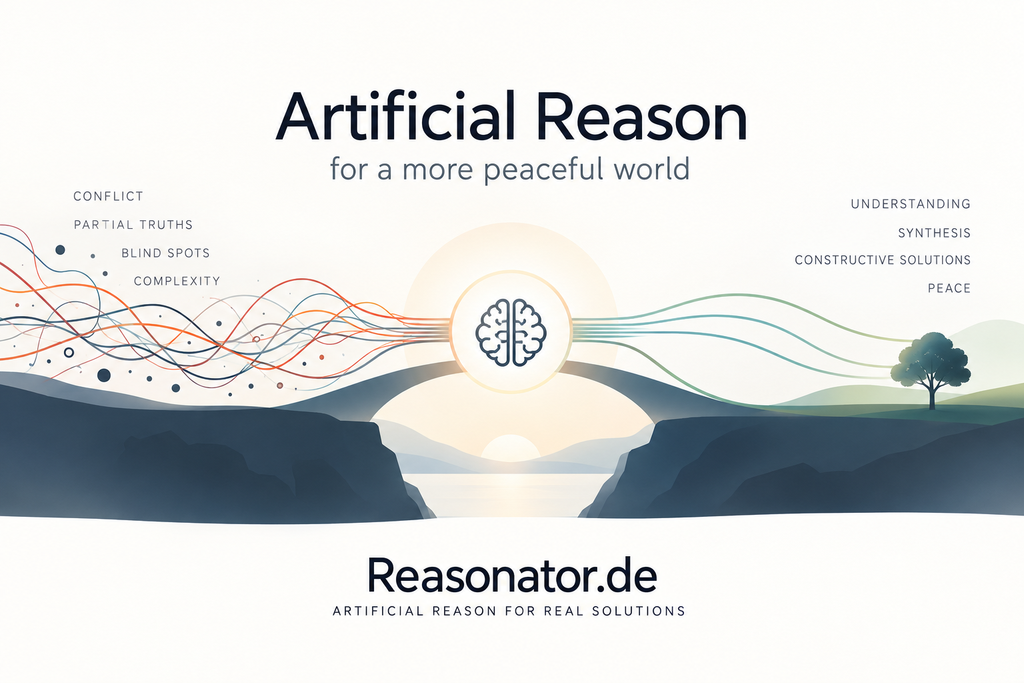
The debate about superintelligence is dominated by one concern: What happens when artificial intelligence becomes more capable than humans?
Perhaps that is not the most important first question. A more interesting one is:
What should a superintelligence actually be able to do in order to benefit us?
More computing power, more knowledge and faster answers are not enough. Highly intelligent people can still behave remarkably irrationally when dealing with social and political problems. Intelligence alone does not solve our problems.
Perhaps we therefore need something else: Artificial Reason.
We use reason in a very simple sense: the application of intelligence and understanding to the solution of real problems. Artificial Reason would therefore be a system that does not merely collect knowledge, but processes it in such a way that understandable solutions can emerge from conflicting insights.
This could eventually become a Peaceful Superintelligence.
Humanity has accumulated an enormous amount of insight. Smith saw something. Marx did too. Keynes, Hayek, Kant, Hegel, Nietzsche, Berne and countless others each discovered important parts of reality. Perhaps the problem is not primarily that we lack great ideas. The problem is that these ideas exist separately and are usually used against one another.
We turn thinkers into camps.
Our Theory of the Relativity of Social Truth begins precisely here:
Every statement about human beings and society can be true and false at the same time as long as its level of reference has not been specified.
A statement may be true for the individual and false for society as a whole. True in the short term and false in the long term. Economically useful and socially harmful. The statement itself has not changed. The level of reference has.
The first question should therefore not be: Who is right?
It should be:
At what level is each side right?
This leads to a different method of thinking: contradiction, separation of levels, partial truths, strengths and weaknesses, synthesis — and only then judgement.
Perhaps the foundations of superintelligence already exist in human knowledge. They are simply distributed.
A sufficiently capable AI could begin to examine many of these insights simultaneously. Not in order to select a winner, but to ask systematically: What did this thinker see correctly? Under what conditions is the idea valid? Where is its strength? Where is its limitation? Which other theory contains a strength precisely where this one becomes weak?
Superintelligence would then not necessarily be a machine that thinks better than humanity.
It could be a system in which humanity’s best ideas are finally able to think together.
This is where paradoxological invisibility becomes important. Parts of reality can in principle be recognizable and nevertheless remain absent from our effective understanding. Sometimes we fail to distinguish levels. Sometimes morality, fear, wishful thinking or identity prevent open examination. Sometimes language hides the distinction we need. And sometimes polarized thinking prevents us from seeing the strengths of the opposing position and the weaknesses of our own.
Those who see only right and wrong can judge.
Those who can see strengths and weaknesses can construct.
Artificial Reason would therefore systematically search for precisely these blind spots. It would separate levels of reference, test conditions of validity, create strengths-and-weaknesses profiles and attempt to combine conflicting partial truths into better constructions.
We call one practical application of this idea Reasonator.de.
It is not intended to be an oracle or a new authority. It is meant to be a tool that makes visible how more reasonable solutions can emerge from different perspectives, goals and partial truths. Artificial Reason is the principle. Reasonator.de would be one way of applying it.
But this immediately raises the most difficult question: Who decides what counts as a strength or a weakness?
A Peaceful Superintelligence cannot simply answer this by authority. Strengths and weaknesses have to be defined in a transparent way. A strength is an aspect of an idea, theory or institution that, under certain conditions and at a certain level of reference, explains or solves a relevant problem well. A weakness appears where the same approach ignores relevant reality, creates harmful side effects or fails at the problem it is supposed to solve.
Every evaluation should therefore answer: A strength for what? A weakness in relation to what? At which level? Under which conditions? With which side effects?
This is also where the question of legitimacy begins.
Why should human beings trust a system that may one day be cognitively far more capable than they are?
Not because it says: I am smarter than you.
But because it shows its reasoning.
A Peaceful Superintelligence would have to make clear which goals were assumed, which facts were considered, which levels were distinguished, which counterarguments were examined and how the proposed synthesis emerged from competing partial truths.
Transparency of method creates legitimacy.
Humans do not need to reproduce the entire information processing capacity of the machine. But they must be able to understand and challenge the logic of its path.
A Peaceful Superintelligence would therefore not be an oracle.
It would be a reason-giving intelligence.
Method alone, however, is not enough. Even highly capable reasoning needs a moral anchor.
Ours would be:
Social contradictions should be resolved as constructively and peacefully as possible.
This does not mean helpless pacifism. A realistic view of human nature does not allow that simplification. People have self-interest, fear, ambition and the ability to gain advantages at the expense of others. Societies therefore need rules and, in some situations, legitimate state power to enforce them.
The rationality trap illustrates the problem well: what appears rational for the individual can produce destructive outcomes for everyone. A reasonable society therefore has to design rules so that individual incentives and collective outcomes fit together as closely as possible.
War is different.
War is the extreme escalation of unresolved political and social contradictions. It destroys human beings, infrastructure and resources and often creates new antagonisms in the process.
A Peaceful Superintelligence would therefore always have to ask first which interests, fears, false assumptions, rationality traps and paradoxological invisibilities are driving a conflict — and whether a construction exists that could resolve it peacefully.
The second anchor is scientific:
a realistic model of human nature.
Social systems must not be designed for human beings who do not exist. Not for the perfectly altruistic citizen, not for the perfectly rational homo economicus, and not for a morally perfected new human being.
Humans are contradictory. We possess intelligence and fear, morality and self-interest, empathy and aggression, cooperation and competition.
A reasonable society has to work with the human being we actually have.
The better human being may become an outcome. It must not be a prerequisite.
This also defines what a Peaceful Superintelligence must not become politically.
It should not decide what human beings are allowed to want. It should not dictate morality and it should not replace democracy.
Goals remain human and democratically legitimized.
Its task would be different:
Find the most constructive, understandable and peaceful ways of reaching those goals under real-world conditions.
That is also what Reasonator.de can stand for: not deciding what people ought to want, but transparently examining which paths are most likely to achieve their goals under real conditions, with the fewest contradictions and the least unnecessary conflict.
Superintelligence would then not mark the end of human reason.
It might instead become the first opportunity to use our fragmented knowledge reasonably as a whole.
Peaceful Superintelligence is the transparent synthesis of humanity’s best partial insights — enabled by Artificial Reason, grounded in a realistic understanding of human nature, and directed toward the peaceful resolution of human contradictions.
Perhaps the first question should therefore not be:
When will superintelligence arrive?
But rather:
Which method do we want to give it before it becomes possible?
Artificial-Reason.org
Reasonator.de
Schreibe einen Kommentar